Friday, 21 December 2012

Pre-Christian background

Pre-Christian background

Dies Natalis Solis Invicti

Dies Natalis Solis Invicti means "the birthday of the unconquered sun".
Some early Christian writers connected the sun to Jesus, who they believed was prophesied in Malachi 4:2 as the "Sun of Righteousness": "O, how wonderfully acted Providence that on that day on which that Sun was born...Christ should be born", a work attributed to Cyprian said.However, this is unrelated to the winter solstice and is instead based on the idea that creation began on 25 March (the first day of the week, Sunday) and that Jesus was born on 28 March, the day of the creation of the sun (the fourth day of the week, Wednesday): "O the splendid and divine providence of the Lord, that on that day, the very day, on which the sun was made, the 28 March, a Wednesday, Christ should be born. For this reason Malachi the prophet, speaking about him to the people, fittingly said, 'Unto you shall the sun of righteousness arise, and healing is in his wings.'"
In the fourth century, John Chrysostom, promoting celebration on 25 December, commented on the connection: "But Our Lord, too, is born in the month of December ... the eight before the calends of January [25 December] ..., But they call it the 'Birthday of the Unconquered'. Who indeed is so unconquered as Our Lord ...? Or, if they say that it is the birthday of the Sun, He is the Sun of Justice."
With regard to a supposed December religious feast of the sun as a god (Sol), rather than a solstice feast of the physical sun, however, "while the winter solstice on or around December 25 was well established in the Roman imperial calendar, there is no evidence that a religious celebration of Sol on that day antedated the celebration of Christmas".

Reformation into the 19th century


Reformation into the 19th century

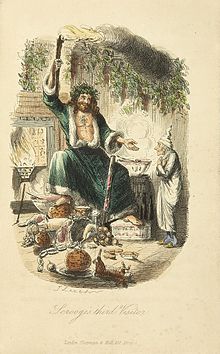
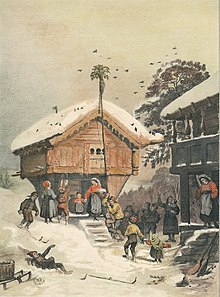
 Following the Protestant Reformation, groups such as the Puritans strongly condemned the celebration of Christmas, considering it a Catholic invention and the "trappings of popery" or the "rags of the Beast." The Catholic Church responded by promoting the festival in a more religiously oriented form. King Charles I of England directed his noblemen and gentry to return to their landed estates in midwinter to keep up their old style Christmas generosity.Following the Parliamentarian victory over Charles I during the English Civil War, England's Puritan rulers banned Christmas in 1647. Protests followed as pro-Christmas rioting broke out in several cities and for weeks Canterbury was controlled by the rioters, who decorated doorways with holly and shouted royalist slogans. The book, The Vindication of Christmas (London, 1652), argued against the Puritans, and makes note of Old English Christmas traditions, dinner, roast apples on the fire, card playing, dances with "plow-boys" and "maidservants", and carol singing The Restoration of King Charles II in 1660 ended the ban, but many clergymen still disapproved of Christmas celebration. In Scotland, the Presbyterian Church of Scotland also discouraged the observance of Christmas, and though James VI commanded its celebration in 1618, attendance at church was scant. The Parliament of Scotland officially abolished the observance of Christmas in 1640, claiming that the church had been "purged of all superstitious observation of days". It was not until 1958 that Christmas again became a Scottish public holiday. In Colonial America, the Puritans of New England shared radical Protestant disapproval of Christmas. Celebration was outlawed in Boston from 1659 to 1681. The ban by the Pilgrims was revoked in 1681 by English governor Sir Edmund Andros, however it was not until the mid-19th century that celebrating Christmas became fashionable in the Boston region. At the same time, Christian residents of Virginia and New York observed the holiday freely. Pennsylvania German Settlers, pre-eminently the Moravian settlers of Bethlehem, Nazareth and Lititz in Pennsylvania and the Wachovia Settlements in North Carolina, were enthusiastic celebrators of Christmas. The Moravians in Bethlehem had the first Christmas trees in America as well as the first Nativity Scenes. Christmas fell out of favor in the United States after the American Revolution, when it was considered an English custom. George Washington attacked Hessian (German) mercenaries on the day after Christmas during the Battle of Trenton on December 26, 1776, Christmas being much more popular in Germany than in America at this time. In the early 19th century, writers imagined Tudor Christmas as a time of heartfelt celebration. In 1843, Charles Dickens wrote the novel A Christmas Carol, that helped revive the 'spirit' of Christmas and seasonal merriment. Its instant popularity played a major role in portraying Christmas as a holiday emphasizing family, goodwill, and compassion. The Queen's Christmas tree at Windsor Castle, published in the Illustrated London News, 1848, and republished in Godey's Lady's Book, Philadelphia, December 1850 Dickens sought to construct Christmas as a family-centered festival of generosity, in contrast to the community-based and church-centered observations, the observance of which had dwindled during the late 18th century and early 19th century. Superimposing his secular vision of the holiday, Dickens influenced many aspects of Christmas that are celebrated today in Western culture, such as family gatherings, seasonal food and drink, dancing, games, and a festive generosity of spirit. A prominent phrase from the tale, 'Merry Christmas', was popularized following the appearance of the story. This coincided with the appearance of the Oxford Movement and the growth of Anglo-Catholicism, which led a revival in traditional rituals and religious observances. The term Scrooge became a synonym for miser, with 'Bah! Humbug!' dismissive of the festive spirit. In 1843, the first commercial Christmas card was produced by Sir Henry Cole. The revival of the Christmas Carol began with William B. Sandys Christmas Carols Ancient and Modern (1833), with the first appearance in print of 'The First Noel', 'I Saw Three Ships', 'Hark the Herald Angels Sing' and 'God Rest Ye Merry, Gentlemen', popularized in Dickens' A Christmas Carol. In Britain, the Christmas tree was introduced in the early 19th century following the personal union with the Kingdom of Hanover, by Charlotte of Mecklenburg-Strelitz, wife of King George III. In 1832, the future Queen Victoria wrote about her delight at having a Christmas tree, hung with lights, ornaments, and presents placed round it. After her marriage to her German cousin Prince Albert, by 1841 the custom became more widespread throughout Britain. An image of the British royal family with their Christmas tree at Windsor Castle, created a sensation when it was published in the Illustrated London News in 1848. A modified version of this image was published in the United States in 1850. By the 1870s, putting up a Christmas tree had become common in America. A Norwegian Christmas, 1846 painting by Adolph Tidemand In America, interest in Christmas had been revived in the 1820s by several short stories by Washington Irving which appear in his The Sketch Book of Geoffrey Crayon and "Old Christmas". Irving's stories depicted harmonious warm-hearted English Christmas festivities he experienced while staying in Aston Hall, Birmingham, England, that had largely been abandoned, and he used the tract Vindication of Christmas (1652) of Old English Christmas traditions, that he had transcribed into his journal as a format for his stories. In 1822, Clement Clarke Moore wrote the poem A Visit From St. Nicholas (popularly known by its first line: Twas the Night Before Christmas). The poem helped popularize the tradition of exchanging gifts, and seasonal Christmas shopping began to assume economic importance. This also started the cultural conflict of the holiday's spiritualism and its commercialism that some see as corrupting the holiday. In her 1850 book "The First Christmas in New England", Harriet Beecher Stowe includes a character who complains that the true meaning of Christmas was lost in a shopping spree. While the celebration of Christmas was not yet customary in some regions in the U.S., Henry Wadsworth Longfellow detected "a transition state about Christmas here in New England" in 1856. "The old puritan feeling prevents it from being a cheerful, hearty holiday; though every year makes it more so". In Reading, Pennsylvania, a newspaper remarked in 1861, "Even our presbyterian friends who have hitherto steadfastly ignored Christmas – threw open their church doors and assembled in force to celebrate the anniversary of the Savior's birth" The First Congregational Church of Rockford, Illinois, 'although of genuine Puritan stock', was 'preparing for a grand Christmas jubilee', a news correspondent reported in 1864. By 1860, fourteen states including several from New England had adopted Christmas as a legal holiday. In 1870, Christmas was formally declared a United States Federal holiday, signed into law by President Ulysses S. Grant. Subsequently, in 1875, Louis Prang introduced the Christmas card to Americans. He has been called the "father of the American Christmas card"

Decorations

Decorations


Decoration

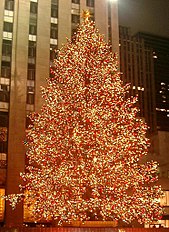
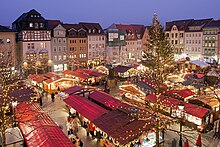
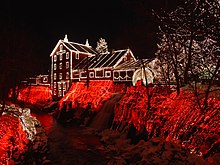
Main article: Christmas decoration See also: Christmas tree, Nativity scene, Christmas lights, Christmas stocking, and Christmas ornament Clifton Mill in Clifton, Ohio is the site of this Christmas display with over 3.5 million lights. The practice of putting up special decorations at Christmas has a long history. In the 15th century, it was recorded that in London it was the custom at Christmas for every house and all the parish churches to be "decked with holm, ivy, bays, and whatsoever the season of the year afforded to be green". The heart-shaped leaves of ivy were said to symbolize the coming to earth of Jesus, while holly was seen as protection against pagans and witches, its thorns and red berries held to represent the Crown of Thorns worn by Jesus at the crucifixion and the blood he shed. Nativity scenes are known from 10th-century Rome. They were popularised by Saint Francis of Asissi from 1223, quickly spreading across Europe. Different types of decorations developed across the Christian world, dependent on local tradition and available resources. The first commercially produced decorations appeared in Germany in the 1860s, inspired by paper chains made by children. In countries where a representation of the Nativity Scene is very popular, people are encouraged to compete and create the most original or realistic ones. Within some families, the pieces used to make the representation are considered a valuable family heirloom. The traditional colors of Christmas are green and red. White, silver and gold are also popular. Red symbolizes the blood of Jesus, which was shed in his crucifixion, while green symbolizes eternal life, and in particular the evergreen tree, which does not lose its leaves in the winter. The famous Rockefeller Center Christmas Tree in New York City The Christmas tree is considered by some as Christianisation of pagan tradition and ritual surrounding the Winter Solstice, which included the use of evergreen boughs, and an adaptation of pagan tree worship; according to eighth-century biographer Æddi Stephanus, Saint Boniface (634–709), who was a missionary in Germany, took an axe to an oak tree dedicated to Thor and pointed out a fir tree, which he stated was a more fitting object of reverence because it pointed to heaven and it had a triangular shape, which he said was symbolic of the TrinityThe English language phrase "Christmas tree" is first recorded in 1835 and represents an importation from the German language. The modern Christmas tree tradition is believed to have begun in Germany in the 18th century though many argue that Martin Luther began the tradition in the 16th century. From Germany the custom was introduced to Britain, first via Queen Charlotte, wife of George III, and then more successfully by Prince Albert during the reign of Queen Victoria. By 1841 the Christmas tree had become even more widespread throughout Britain. By the 1870s, people in the United States had adopted the custom of putting up a Christmas tree. Christmas trees may be decorated with lights and ornaments. Since the 19th century, the poinsettia, a native plant from Mexico, has been associated with Christmas. Other popular holiday plants include holly, mistletoe, red amaryllis, and Christmas cactus. Along with a Christmas tree, the interior of a home may be decorated with these plants, along with garlands and evergreen foliage. The display of Christmas villages has also become a tradition in many homes during this season. The outside of houses may be decorated with lights and sometimes with illuminated sleighs, snowmen, and other Christmas figures. Other traditional decorations include bells, candles, candy canes, stockings, wreaths, and angels. Both the displaying of wreaths and candles in each window are a more traditional Christmas display. The concentric assortment of leaves, usually from an evergreen, make up Christmas wreaths and are designed to prepare Christians for the Advent season. Candles in each window are meant to demonstrate the fact that Christians believe that Jesus Christ is the ultimate light of the world. Christmas lights and banners may be hung along streets, music played from speakers, and Christmas trees placed in prominent places. It is common in many parts of the world for town squares and consumer shopping areas to sponsor and display decorations. Rolls of brightly colored paper with secular or religious Christmas motifs are manufactured for the purpose of wrapping gifts. In some countries, Christmas decorations are traditionally taken down on Twelfth Night, the evening of January 5.

Commemorating Jesus' birth

Commemorating Jesus' birth

 Christians celebrate the birth of Jesus to the Virgin Mary as a fulfillment of the Old Testament's Messianic prophecy. The Bible contains two accounts which describe the events surrounding Jesus' birth. Depending on one's perspective, these accounts either differ from each other or tell two versions of the same story. These biblical accounts are found in the Gospel of Matthew, namely Matthew 1:18, and the Gospel of Luke, specifically Luke 1:26 and 2:40. According to these accounts, Jesus was born to Mary, assisted by her husband Joseph, in the city of Bethlehem. On Christmas Day, the Christ Candle in the center of the Advent wreath is traditionally lit in many church services. According to popular tradition, the birth took place in a stable, surrounded by farm animals. A manger (that is, a feeding trough) is mentioned in Luke 2:7, where it states Mary "wrapped him in swaddling clothes and laid him in a manger, because there was no room for them in the inn" (KJV); and "She wrapped him in cloths and placed him in a manger, because there was no guest room available for them" (NIV). Shepherds from the fields surrounding Bethlehem were told of the birth by an angel, and were the first to see the child. Popular tradition also holds that three kings or wise men (named Melchior, Caspar, and Balthazar) visited the infant Jesus in the manger, though this does not strictly follow the Biblical account. The Gospel of Matthew instead describes a visit by an unspecified number of magi, or astrologers, sometime after Jesus was born while the family was living in a house (Matthew 2:11), who brought gifts of gold, frankincense, and myrrh to the young child Jesus. The visitors were said to be following a mysterious star, commonly known as the Star of Bethlehem, believing it to announce the birth of a king of the Jews. The commemoration of this visit, the Feast of Epiphany celebrated on January 6, is the formal end of the Christmas season in some churches. Christians celebrate Christmas in various ways. In addition to this day being one of the most important and popular for the attendance of church services, there are other devotions and popular traditions. In some Christian denominations, children re-enact the events of the Nativity with animals to portray the event with more realism or sing carols that reference the event. Some Christians also display a small re-creation of the Nativity, known as a Nativity scene or crèche, in their homes, using figurines to portray the key characters of the event. Prior to Christmas Day, the Eastern Orthodox Church practices the 40-day Nativity Fast in anticipation of the birth of Jesus, while much of Western Christianity celebrates four weeks of Advent. The final preparations for Christmas are made on Christmas Eve, and many families' major observation of Christmas actually falls in the evening of this day. A long artistic tradition has grown of producing painted depictions of the nativity in art. Nativity scenes are traditionally set in a stable with livestock and include Mary, Joseph, the infant Jesus in the manger, the three wise men, the shepherds and their sheep, the angels, and the Star of Bethlehem.

Celebration

Celebration

 Christmas Day is celebrated as a major festival and public holiday in countries around the world, including many whose populations are mostly non-Christian. In some non-Christian countries, periods of former colonial rule introduced the celebration (e.g. Hong Kong); in others, Christian minorities or foreign cultural influences have led populations to observe the holiday. Countries such as Japan, where Christmas is popular despite there being only a small number of Christians, have adopted many of the secular aspects of Christmas, such as gift-giving, decorations and Christmas trees. Countries in which Christmas is not a formal public holiday include China, (excepting Hong Kong and Macao), Japan, Saudi Arabia, Algeria, Thailand, Iran, Turkey and North Korea. Christmas celebrations around the world can vary markedly in form, reflecting differing cultural and national traditions. Among countries with a strong Christian tradition, a variety of Christmas celebrations have developed that incorporate regional and local cultures. For Christians, participating in a religious service plays an important part in the recognition of the season. Christmas, along with Easter, is the period of highest annual church attendance. In Catholic countries, people hold religious processions or parades in the days preceding Christmas. In other countries, secular processions or parades featuring Santa Claus and other seasonal figures are often held. Family reunions and the exchange of gifts are a widespread feature of the season. Gift giving takes place on Christmas Day in most countries. Others practice gift giving on December 6, Saint Nicholas Day, and January 6, Epiphany.

Etymology


Etymology

 "Christmas" is a compound word originating in the term "Christ's Mass". It is derived from the Middle English Cristemasse, which is from Old English Crīstesmæsse, a phrase first recorded in 1038. Crīst (genitive Crīstes) is from Greek Khrīstos (Χριστός), a translation of Hebrew Māšîaḥ (מָשִׁיחַ), "Messiah"; and mæsse is from Latin missa, the celebration of the Eucharist. The form "Christenmas" was also historically used, but is now considered archaic and dialectal; it derives from Middle English Cristenmasse, literally "Christian mass" "Xmas" is an abbreviation of Christmas found particularly in print, based on the initial letter chi (Χ) in Greek Khrīstos (Χριστός), "Christ", though numerous style guides discourage its use; it has precedent in Middle English Χρ̄es masse (where "Χρ̄" is an abbreviation for Χριστός).

Celebration

Christmas Day is celebrated as a major festival and public holiday in countries around the world, including many whose populations are mostly non-Christian. In some non-Christian countries, periods of former colonial rule introduced the celebration (e.g. Hong Kong); in others, Christian minorities or foreign cultural influences have led populations to observe the holiday. Countries such as Japan, where Christmas is popular despite there being only a small number of Christians, have adopted many of the secular aspects of Christmas, such as gift-giving, decorations and Christmas trees. Countries in which Christmas is not a formal public holiday include China, (excepting Hong Kong and Macao), Japan, Saudi Arabia, Algeria, Thailand, Iran, Turkey and North Korea. Christmas celebrations around the world can vary markedly in form, reflecting differing cultural and national traditions. Among countries with a strong Christian tradition, a variety of Christmas celebrations have developed that incorporate regional and local cultures. For Christians, participating in a religious service plays an important part in the recognition of the season. Christmas, along with Easter, is the period of highest annual church attendance. In Catholic countries, people hold religious processions or parades in the days preceding Christmas. In other countries, secular processions or parades featuring Santa Claus and other seasonal figures are often held. Family reunions and the exchange of gifts are a widespread feature of the season. Gift giving takes place on Christmas Day in most countries. Others practice gift giving on December 6, Saint Nicholas Day, and January 6, Epiphany.

Commemorating Jesus' birth

 Christians celebrate the birth of Jesus to the Virgin Mary as a fulfillment of the Old Testament's Messianic prophecy. The Bible contains two accounts which describe the events surrounding Jesus' birth. Depending on one's perspective, these accounts either differ from each other or tell two versions of the same story. These biblical accounts are found in the Gospel of Matthew, namely Matthew 1:18, and the Gospel of Luke, specifically Luke 1:26 and 2:40. According to these accounts, Jesus was born to Mary, assisted by her husband Joseph, in the city of Bethlehem. On Christmas Day, the Christ Candle in the center of the Advent wreath is traditionally lit in many church services. According to popular tradition, the birth took place in a stable, surrounded by farm animals. A manger (that is, a feeding trough) is mentioned in Luke 2:7, where it states Mary "wrapped him in swaddling clothes and laid him in a manger, because there was no room for them in the inn" (KJV); and "She wrapped him in cloths and placed him in a manger, because there was no guest room available for them" (NIV). Shepherds from the fields surrounding Bethlehem were told of the birth by an angel, and were the first to see the child. Popular tradition also holds that three kings or wise men (named Melchior, Caspar, and Balthazar) visited the infant Jesus in the manger, though this does not strictly follow the Biblical account. The Gospel of Matthew instead describes a visit by an unspecified number of magi, or astrologers, sometime after Jesus was born while the family was living in a house (Matthew 2:11), who brought gifts of gold, frankincense, and myrrh to the young child Jesus. The visitors were said to be following a mysterious star, commonly known as the Star of Bethlehem, believing it to announce the birth of a king of the Jews. The commemoration of this visit, the Feast of Epiphany celebrated on January 6, is the formal end of the Christmas season in some churches. Christians celebrate Christmas in various ways. In addition to this day being one of the most important and popular for the attendance of church services, there are other devotions and popular traditions. In some Christian denominations, children re-enact the events of the Nativity with animals to portray the event with more realism or sing carols that reference the event. Some Christians also display a small re-creation of the Nativity, known as a Nativity scene or crèche, in their homes, using figurines to portray the key characters of the event. Prior to Christmas Day, the Eastern Orthodox Church practices the 40-day Nativity Fast in anticipation of the birth of Jesus, while much of Western Christianity celebrates four weeks of Advent. The final preparations for Christmas are made on Christmas Eve, and many families' major observation of Christmas actually falls in the evening of this day. A long artistic tradition has grown of producing painted depictions of the nativity in art. Nativity scenes are traditionally set in a stable with livestock and include Mary, Joseph, the infant Jesus in the manger, the three wise men, the shepherds and their sheep, the angels, and the Star of Bethlehem.

chirstmas

chirstmas

Christmas"Christmas Day" redirects here. For other uses, see Christmas (disambiguation) and Christmas Day (disambiguation). Page semi-protected Christmas Christmas A depiction of the Nativity with a Christmas tree backdrop Also called Noel, Nativity, Yule, Xmas Observed by Christians Many non-Christians Type Christian, cultural Significance Traditional birthday of Jesus Date December 25 (alternatively January 6,
A depiction of the Nativity with 7 or 19) (see below) Observances Church services, gift giving, family and other social gatherings, symbolic decorating Related to Christmastide, Christmas Eve, Advent, Annunciation, Epiphany, Baptism of the Lord, Yule Christmas (Old English: Crīstesmæsse, meaning "Christ's Mass") is an annual commemoration of the birth of Jesus Christ and a widely observed holiday, celebrated generally on December 25 by millions of people around the world. A feast central to the Christian liturgical year, it closes the Advent season and initiates the twelve days of Christmastide. Christmas is a civil holiday in many of the world's nations, is celebrated by an increasing number of non-Christians, and is an integral part of the Christmas and holiday season. The precise year of Jesus' birth, which some historians place between 7 and 2 BC, is unknown. His birth is mentioned in two of the four Canonical Gospels. By the early-to-mid 4th century, the Western Christian Church had placed Christmas on December 25, a date later adopted in the East. The date of Christmas may have initially been chosen to correspond with the day exactly nine months after early Christians believed Jesus to have been conceived, as well as the date of celebration of the southern solstice (i.e., the Roman winter solstice), with a sun connection being possible because Christians consider Jesus to be the "Sun of righteousness" prophesied in Malachi 4:2. The original date of the celebration in Eastern Christianity was January 6, in connection with Epiphany, and that is still the date of the celebration for the Armenian Apostolic Church and in Armenia, where it is a public holiday. As of 2012, there is a difference of 13 days between the modern Gregorian calendar and the older Julian calendar. Those who continue to use the Julian calendar or its equivalents thus celebrate December 25 and January 6 on what for the majority of the world is January 7 and January 19. For this reason, Ethiopia, Russia, Ukraine, Serbia, the Republic of Macedonia, and the Republic of Moldova celebrate Christmas on what in the Gregorian calendar is January 7; the Church of Greece celebrates Christmas on December 25. The popular celebratory customs associated in various countries with Christmas have a mix of pre-Christian, Christian and secular themes and origins. Popular modern customs of the holiday include gift giving, Christmas music and caroling, an exchange of Christmas cards, church celebrations, a special meal, and the display of various Christmas decorations, including Christmas trees, Christmas lights, nativity scenes, garlands, wreaths, mistletoe, and holly. In addition, several closely related and often interchangeable figures, known as Santa Claus, Father Christmas, Saint Nicholas and Christkind, are associated with bringing gifts to children during the Christmas season and have their own body of traditions and lore. Because gift-giving and many other aspects of the Christmas festival involve heightened economic activity among both Christians and non-Christians, the holiday has become a significant event and a key sales period for retailers and businesses. The economic impact of Christmas is a factor that has grown steadily over the past few centuries in many regions of the world.
 http://en.wikipedia.org/wiki/Christmas